

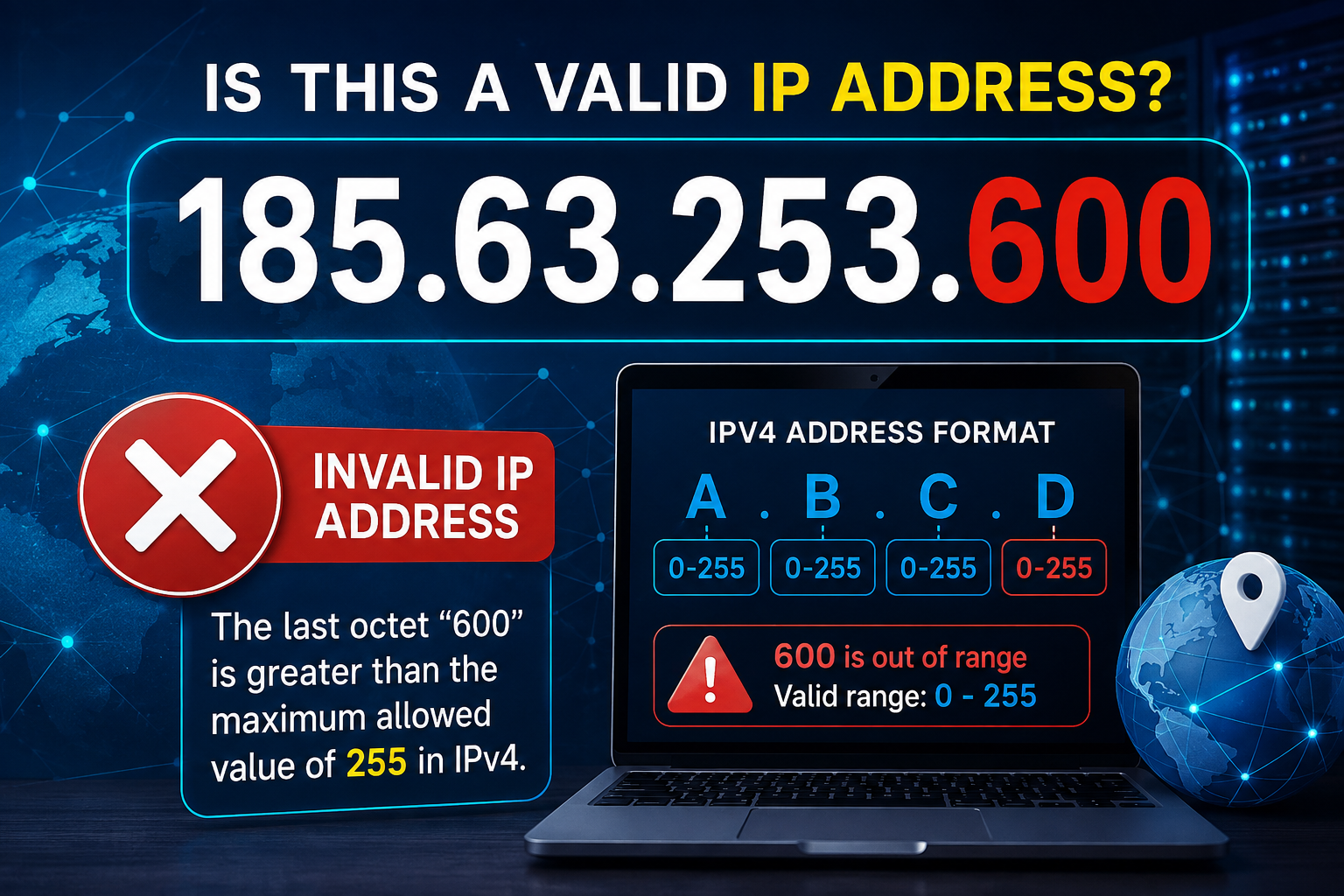
185.63.253.600 looks like an IPv4 address at first glance, but there is an important problem with it: it is not a valid IPv4 address. The reason is simple. IPv4 addresses contain four numerical sections separated by dots, and every section must fall between 0 and 255. In this case, the final section is 600, which is outside the permitted range. If you came across this number in a log, website, message, security alert, or technical document, it may be a typing mistake, a copied value, or an incorrectly formatted address.
What Is 185.63.253.600?
185.63.253.600 is formatted to look like an Internet Protocol address, commonly called an IP address. An IP address helps identify a device or network interface when it communicates over a network. However, the number does not meet the technical rules for a standard IPv4 address because one of its four parts is too large. That distinction matters because a number can look like an IP address without actually being usable as one.
Why 185.63.253.600 Is Invalid
The biggest issue with 185.63.253.600 is the final number. A standard IPv4 address follows the format A.B.C.D, with each value ranging from 0 through 255. The first three sections, 185, 63, and 253, are within that range. The final section, 600, is not. Since 600 is greater than 255, the complete address cannot represent a valid IPv4 address.
The Basic Rules of IPv4 Addresses
IPv4 addresses contain four octets, and each octet can contain a value from 0 to 255. For example, an address such as 192.168.1.1 follows the rules because every section is within the allowed range. An address such as 185.63.253.600 breaks those rules because the final octet exceeds the maximum value. This is one of the easiest ways to recognize an invalid IPv4 address.
Could 185.63.253.600 Be a Typing Mistake?
Yes, and that is one of the most likely explanations. People often enter long numerical strings manually, copy information incorrectly, or accidentally add an extra digit. Someone may have intended to write a different address, especially if the number appeared in a technical note or message without additional context. The important point is that you should not assume the intended IP address without checking the original source.
What Might the Correct IP Address Be?
There is no reliable way to determine the intended address simply from 185.63.253.600. Several different corrections could theoretically be possible. For example, the last section might have been entered incorrectly, or the entire sequence could have been copied from another identifier. Guessing would create more confusion, particularly if the address is connected to a security investigation, server configuration, or network record. The safest approach is to return to the original source and verify the number.
Is 185.63.253.600 a Public IP Address?
Although the first three sections resemble a public IPv4 address, the complete value is not a valid IPv4 address. Therefore, it should not be treated as a working public IP address. A genuine public IP must satisfy the IPv4 formatting rules before questions about ownership, geographic location, hosting providers, or network activity can be answered meaningfully.
Can You Trace 185.63.253.600?
You cannot meaningfully trace 185.63.253.600 as a standard IPv4 address because the address itself is invalid. IP lookup services generally require a properly formatted address. If the number came from a server log or security report, first confirm whether the final portion was copied correctly. Once a valid address is identified, legitimate IP lookup tools may provide general information such as an approximate region, network operator, or autonomous system, although they normally cannot reveal a person’s exact physical location.
Does an Invalid IP Mean Someone Is Hacking You?
Not necessarily. Seeing an invalid IP-like number does not, by itself, prove hacking, fraud, or malicious activity. It could result from a software error, malformed log entry, incorrect data conversion, manual typing, or simple human error. Security concerns should be based on the wider context, such as repeated login attempts, unfamiliar account activity, unusual network traffic, or other verified indicators.
Why IP Addresses Matter
IP addresses are important because networks use them to identify endpoints and route traffic. When you visit a website, connect to an online service, or communicate with another device, IP addressing helps networking equipment know where information should go. However, an IP address is not automatically a person’s identity. Multiple people can share an address, businesses can use shared networks, and addresses can change over time.
IPv4 and IPv6 Are Different
It is also useful to understand the difference between IPv4 and IPv6. IPv4 uses four decimal sections separated by dots, while IPv6 uses a much longer hexadecimal format separated by colons. The value 185.63.253.600 resembles IPv4 notation, so the IPv4 range rules apply. It cannot be treated as an IPv6 address simply because one of its numbers is too large.
What Does the Number 600 Mean Here?
The 600 at the end is not a valid IPv4 octet. In IPv4 notation, each octet represents eight binary bits, which creates a maximum possible decimal value of 255. Once a section reaches 256 or higher, it no longer fits the standard IPv4 structure. Therefore, 600 is not a special IP value or hidden networking code; it is simply outside the valid range for an IPv4 octet.
Could It Be an Internal Network Address?
The invalid formatting remains a problem regardless of whether someone intended the address to be public or private. Private IPv4 ranges include addresses such as 10.0.0.0 through 10.255.255.255, 172.16.0.0 through 172.31.255.255, and 192.168.0.0 through 192.168.255.255. An address outside those ranges may be publicly routable, but it still has to follow the basic 0-to-255 rule for every octet.
What Should You Do If You Found It in a Log?
If 185.63.253.600 appeared in a log file, do not immediately treat it as a malicious external address. First inspect the surrounding entries and check whether the application recorded malformed data. Look for timestamps, connection details, request information, and nearby IP addresses. If the record belongs to a security system, compare it with the original event or raw log before drawing conclusions.
What If You Received It in a Message?
If someone sent you 185.63.253.600 and described it as an IP address, ask them to verify the value. This is particularly important if they are asking you to connect to a server, change network settings, whitelist an address, or investigate suspicious activity. A small numerical error can send troubleshooting in the wrong direction, so verification is worth the extra minute.
How to Check an IP Address Manually
Checking an IPv4 address is straightforward. Separate the address into its four sections and examine each number individually. Every section must be an integer from 0 to 255. For 185.63.253.600, the first three sections pass that basic test, while the final section fails because 600 is greater than 255. That makes the entire value invalid as a conventional IPv4 address.
Why Guessing the Address Can Be Risky
It may be tempting to change 600 to another number and assume you have discovered the intended address. That approach is unreliable. There could be hundreds of possible corrections, and choosing the wrong one could lead you to investigate the wrong server or network. When accuracy matters, especially in cybersecurity or technical troubleshooting, the original data should always take priority over assumptions.
Is This Number a Phone Number?
No. 185.63.253.600 follows the visual pattern of an IP-like address rather than a conventional telephone number. The four-part dotted format strongly suggests that the number was intended to represent an IPv4 address. However, its final section makes it invalid under standard IPv4 rules. Context is still important because numerical strings can be used for many different purposes.
Could It Be a Server Identifier?
Possibly, but the number itself does not prove that. Some systems use internal identifiers, asset numbers, database values, or other codes that happen to contain dots. If 185.63.253.600 appeared in software rather than a network setting, it may not have been intended as an IP address at all. Looking at the label, field name, surrounding text, and application that produced it can help clarify its purpose.
The Difference Between an IP-Looking String and a Real IP
This is an easy distinction to overlook. A string such as 185.63.253.600 visually resembles an IPv4 address, but appearance is not enough. A valid IPv4 address must satisfy both the structural and numerical requirements. In other words, four numbers separated by dots do not automatically make a usable IP address. Each part must fit within the defined range.
Common Mistakes With IP Addresses
Mistakes can happen when IP addresses are copied from screenshots, emails, spreadsheets, handwritten notes, or scanned documents. A single extra digit can make an otherwise familiar address invalid. Formatting software can also introduce unexpected characters or values. Before troubleshooting a network issue, always confirm that the address has four sections and that each section contains a valid value.
How to Avoid IP Address Confusion
The easiest way to avoid confusion is to copy addresses directly from reliable technical sources instead of retyping them. If you are documenting an address, preserve the original value and explain where it came from. For security-related work, keep the timestamp and surrounding event information as well. An IP address without context can tell you very little, and an invalid one tells you even less.
Does the Invalid Address Reveal a Location?
No. You cannot reliably determine a geographic location from 185.63.253.600 because it is not a valid IPv4 address. Even with a valid IP, geolocation is generally approximate rather than an exact street-level location. IP databases can identify network registrations or approximate regions, but they should not be treated as definitive evidence of where a particular person is located.
Can an IP Address Identify a Person?
A valid IP address generally identifies a network connection or endpoint, not a specific individual. Internet service providers may have additional records that connect an address to a subscriber under appropriate circumstances, but ordinary public lookup tools do not provide that level of personal identification. This is another reason to avoid making strong claims based on an unfamiliar IP address alone.
What This Means for 185.63.253.600
The main takeaway is simple: 185.63.253.600 is not a valid IPv4 address because 600 exceeds the maximum allowed octet value of 255. If you encountered it online or in a technical record, treat it as an invalid or potentially mistyped value until the original source confirms otherwise. There is no reason to assume that the number represents a dangerous website, a hacker, or a specific person simply because it looks like an IP address.
Conclusion
Numbers can look surprisingly official, especially when they appear in logs, security alerts, or technical documents. 185.63.253.600 is a good example of why checking the basic rules matters. Its format resembles IPv4, but the final value makes it invalid. If you found this number somewhere important, the best next step is not to guess what it means. Verify the original record, check the surrounding information, and confirm the intended address before taking action.
FAQs
Is 185.63.253.600 a valid IP address?
No. It is not a valid IPv4 address because the final octet is 600, while every IPv4 octet must be between 0 and 255.
Why is 185.63.253.600 invalid?
The problem is the last section, 600. IPv4 addresses cannot contain an octet greater than 255, so the complete address fails the standard IPv4 format rules.
Can I look up 185.63.253.600?
You can search for the exact string, but standard IP lookup services will not treat it as a valid IPv4 address. Verify the number before attempting an IP lookup.
Does 185.63.253.600 belong to a hacker?
There is no evidence from the number alone to make that claim. Because the address is invalid, it may simply be a typo, malformed data, or another type of identifier.
Can 185.63.253.600 reveal someone’s location?
No. An invalid IPv4 address cannot provide meaningful IP geolocation. Even valid IP addresses generally provide only approximate network or geographic information.
Read also: 5107680508 Phone Number, Reports, Safety Tips & More




Leave a Reply